
Introduction: The Invisible Pulse That Moves the World #
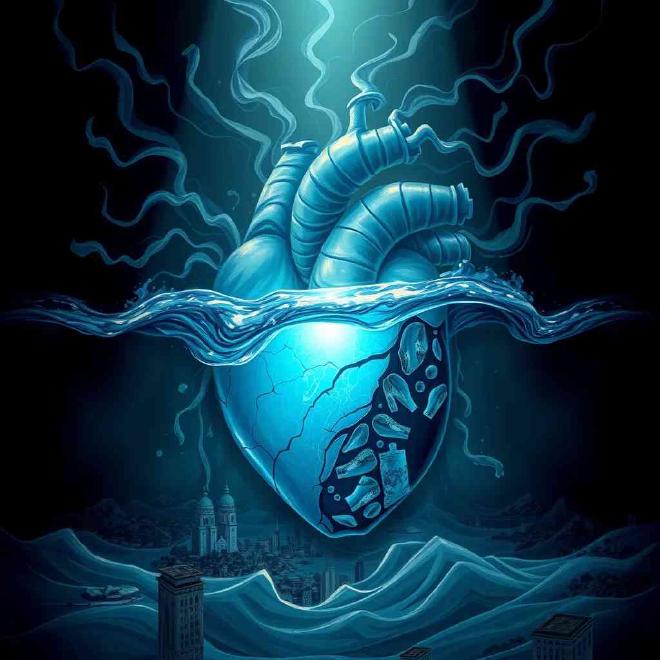
Imagine the ocean as a colossal living being. Just as our bodies rely on the steady beat of the heart to circulate blood, the Earth’s oceans have a massive circulation system that moves water, heat, and nutrients around the globe. This system is called the Atlantic Meridional Overturning Circulation (AMOC), often referred to as the ocean’s “heart.”
But that heart is now weakening. A silent signal from the deep, almost imperceptible, yet carrying profound global consequences. In this article, we’ll dive into what is happening to the ocean’s “heart,” why it’s slowing down, and what this means for the future of humanity.
What Is the Ocean’s Heart (AMOC)? #
AMOC is a vast ocean current that acts like a giant conveyor belt. It carries warm water from the tropics northward into the North Atlantic, where the water cools, becomes denser, and sinks, flowing back southward at depth. This cycle not only moves water but also redistributes heat, carbon, and nutrients, maintaining the climatic balance that has supported life for millennia.
Without AMOC, Europe could freeze, the tropics could overheat, and global weather patterns would become dangerously unpredictable.
Shocking Fact: AMOC Is at Its Weakest in 1,600 Years #
Research published in Nature Geoscience and Nature Climate Change (2021) shows that AMOC is now at its weakest state in over 1,600 years. Data from Greenland ice cores, ocean sediments, and coral growth rings reveal a consistent decline since the late 19th century, with an alarming acceleration after the industrial era.
Main Causes: #
- Global Warming
Rising global temperatures from greenhouse gas emissions are melting Greenland’s ice and other ice sheets. - Freshwater Influx
Meltwater dilutes seawater, lowering its density and disrupting the sinking process in the North Atlantic — the engine of AMOC. - Increased Rainfall & River Discharge
Climate change intensifies rainfall and river flows into the ocean, further accelerating the slowdown.
What Are the Impacts? This Is No Longer Science Fiction #
You might ask, “What does this mean for me?” The answer: a lot.
1. More Frequent Extreme Weather #
AMOC weakening disrupts the jet stream, triggering more extreme weather, including stronger storms in Europe and the US.
2. Higher Sea Level Rise on the US East Coast #
A weakened AMOC pushes local sea level rise higher along the US East Coast than the global average.
3. Threat to Amazon & Asian Monsoon #
Global climate systems become chaotic, threatening the Amazon with prolonged drought and disrupting vital monsoon rains in South Asia.
4. Ocean Ecosystem Collapse #
Without normal circulation, ocean layers become stagnant, reducing oxygen levels, threatening marine species, and disrupting global fisheries.
Are We Approaching the Point of No Return? #
Many scientists fear we are nearing a tipping point — a critical threshold where AMOC could collapse entirely, and changes become irreversible on a human timescale. Some models predict this could happen before the end of this century if greenhouse gas emissions continue unabated.
However, the scientific community also warns: these predictions carry uncertainties. AMOC is a complex system that defies precise forecasts.
Hope: There Is Still Time to Act #
Though this news is alarming, we still have time. Aggressively cutting carbon emissions, protecting forests, and transitioning to clean energy are key to slowing AMOC’s decline.
The ocean has given us everything — oxygen, food, and a stable climate. Now, it’s time we listen to its weakening heartbeat and act.
Conclusion #
The slowdown of the ocean’s heart is a stark warning from Earth’s systems, now trembling under human pressure. This is not a distant future problem — it’s a challenge we must confront now. There is no Planet B, and no second ocean to call home.
As the ocean’s heart weakens, our future trembles with it.